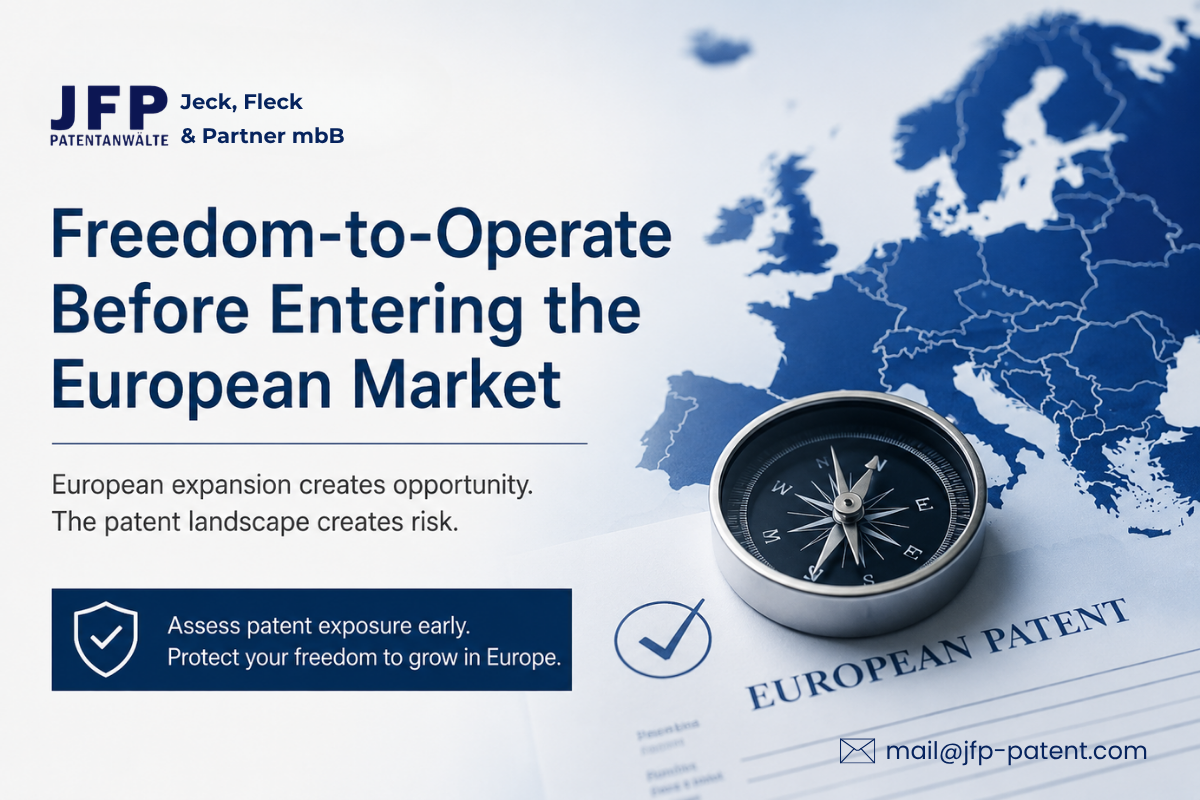
Freedom-to-Operate Before Entering the European Market
Many companies approach European market entry primarily as a commercial expansion decision.
The focus naturally falls on manufacturing, logistics, distribution, regulatory requirements, localisation, and revenue growth.
What receives less attention is how dramatically the surrounding patent landscape may change once products enter Europe.
Patent rights remain territorial.
That means freedom-to-operate considerations may look very different across jurisdictions, even when the underlying product remains unchanged.
For companies preparing European expansion, this distinction can become strategically important much earlier than expected.
European Expansion Changes the Risk Environment
A product that appears commercially stable in one market may face a completely different competitive patent landscape in Europe.
Different jurisdictions may involve:
- different active patent rights
- different enforcement approaches
- different litigation dynamics
- different procedural mechanisms
- different strategic behaviours from competitors
This creates a more fragmented environment than many businesses initially anticipate.
The challenge is not only legal complexity.
It is operational exposure.
Once European expansion begins, businesses often become increasingly dependent on structures that are expensive to modify later.
Why Territorial Patent Risk Matters Commercially
Many companies underestimate how quickly infringement concerns can affect broader commercial planning.
At early stages, redesigning products or adjusting technical implementations may still be realistic.
Later, flexibility becomes more limited.
By the time European launch activity accelerates, businesses may already have:
- manufacturing commitments
- distribution arrangements
- local partnerships
- regulatory investments
- customer expectations
- market-specific infrastructure
At that stage, even relatively narrow patent conflicts can create wider strategic pressure.
This may affect:
- launch timing
- licensing negotiations
- investor confidence
- supply chain continuity
- scalability planning
- long-term European positioning
The Unified Patent Court Has Changed Strategic Exposure
The introduction of the Unified Patent Court has also altered the European patent environment significantly for many businesses.
Competitors may now pursue enforcement strategies capable of affecting multiple participating jurisdictions simultaneously.
For companies unfamiliar with European patent structures, this can create unexpected concentration of commercial risk.
The issue is not only whether infringement exists.
It is how efficiently competitors may be able to enforce rights across multiple territories.
For SMEs, startups, and international technology businesses, this increases the importance of strategic visibility before expansion becomes operationally fixed.
Why Timing Often Determines Strategic Flexibility
One of the most important commercial advantages of early freedom-to-operate review is optionality.
At earlier stages, companies usually retain more flexibility to:
adjust technical structures, redesign components, reconsider jurisdictions, evaluate licensing strategy, or modify implementation approaches.
Once European market entry is already underway, those adjustments may become significantly more expensive.
In many situations, businesses only reassess surrounding patent exposure after competitors become commercially aware of the product.
By then, strategic flexibility may already be narrower than expected.
FTO Is Part of Market Entry Strategy
Freedom-to-operate should not be viewed only as a legal exercise.
For many businesses, it forms part of broader commercial planning.
Strong European expansion strategy usually considers:
- operational scalability
- competitive positioning
- enforcement exposure
- licensing leverage
- investor perception
- long-term commercial resilience
Patent protection and market access are closely connected.
Treating them separately often creates avoidable strategic blind spots.
Conclusion
European market entry creates opportunities for growth, expansion, and long-term commercial positioning.
At the same time, it can introduce new layers of patent exposure that many businesses underestimate during early planning stages.
The strongest international strategies usually assess these issues before operational commitments become difficult to change.
Because once expansion accelerates, the cost of resolving patent conflicts often increases significantly.
Many companies only revisit these questions after commercial dependency on the market has already grown.
At that stage, the available strategic options may already be more limited than expected.